Every one of us uses door locks to secure and protect his/her properties and beloved ones. But have you ever started to consider what is actually happening inside that lock? Most people consider a lock to be a single piece of equipment, but in reality, it’s a master blend of a number of disparate pieces of equipment to provide security, convenience, and peace of mind.
Essential Components
Knowing the parts of a door lock can be beneficial not only to locksmiths, but also for anyone who wishes to know how to fix a broken lock, make their home more secure or simply learn about the way it functions.
This guide breaks down each of the main components of a door lock in a very practical way. Therefore, not only do you know what the names of the parts of a lock are, but you will also have an understanding of how they all work together.
Cylinder
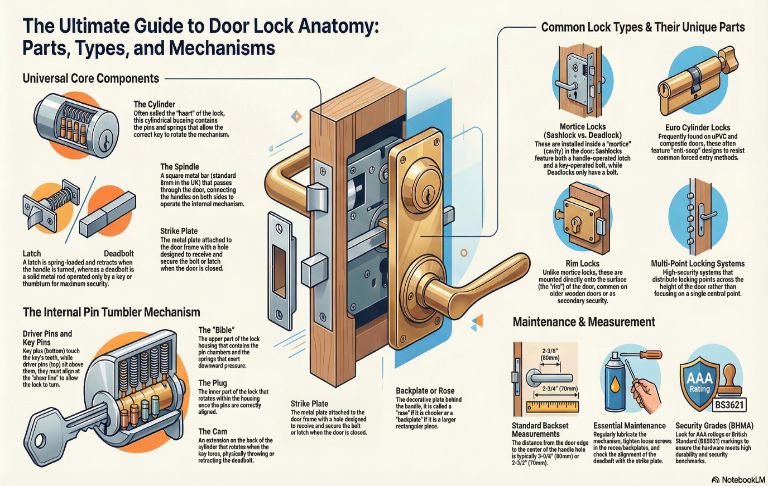
The cylinder, or the body of the lock, is the fundamental heart of any door lock. The process of creating a cylinder is intricate and intentional. Inside, finely cut mechanisms interface with the key so that only the appropriate key can unlock the lock.
This coordination is what prevents others from entering, and thus the cylinder is the most critical piece of a lock in terms of security. The significance of the cylinder cannot be overemphasized.
A poorly designed or weakened cylinder can render even a better lock worthless. A superior cylinder adds security with smooth, reliable operation over the life of the lock.
Types of Cylinders
- Pin Tumbler Cylinder: The pin tumbler cylinder is the most common variety found on household doors. It involves a group of spring-loaded pins that must be aligned perfectly with the grooves of the key in order to rotate. When the correct key is placed, the pins are aligned on the shear line, thus enabling the cylinder to turn and unlock the door. Pin tumbler cylinders are very widely applied as they offer a suitable balance between security, affordability, and ease of use.
- Wafer Cylinder: Wafer cylinders are simpler to design and are commonly used in cabinets, office devices, and some automobiles. Wafer cylinders utilize flat wafers that shift into position by being inserted using the correct key instead of pins. While easier to use and manufacture, wafer cylinders are less pick-resistant than pin tumblers and thus are applied best in low-security applications.
- Disc Detainer Cylinder: Disc detainer cylinders are a higher level of security. They are not composed of pins or wafers but of rotating discs which must be positioned in a very precise manner so that the cylinder can be rotated. Disc detainer cylinders are highly resistant to picking, drilling, and other types of tampering and are hence fit for commercial use, high-security doors, and safes.
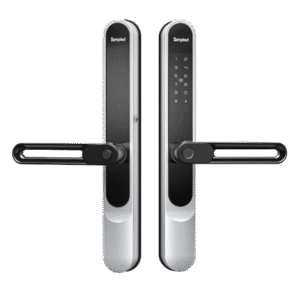
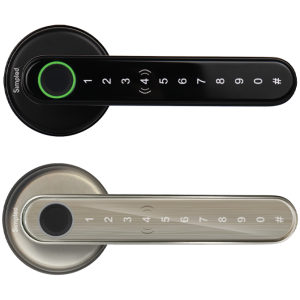
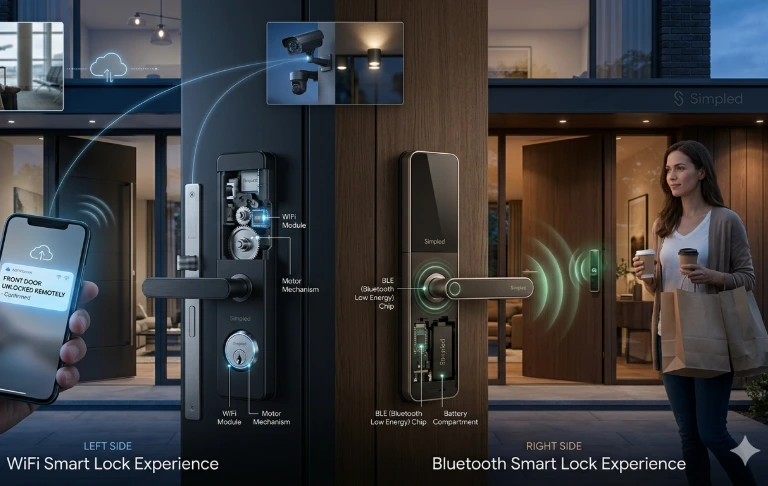
- smart cylinders: A smart cylinder is essentially a lock cylinder that integrates smart technology, allowing you to control and monitor access without traditional keys. These cylinders are commonly used in smart locks and can be installed in place of standard mechanical cylinders.
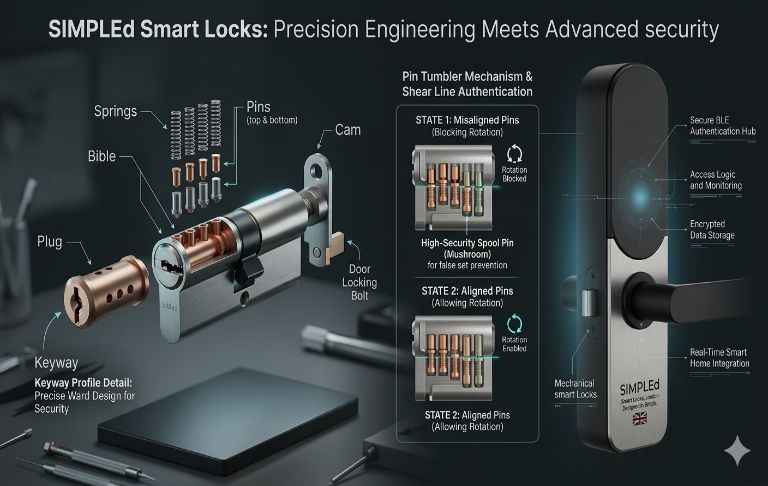
Different parts of the cylinder
Next, we will explain the different parts of the cylinder
Keyway
Beyond simply being an opening for the key to go into the lock, it is also considered a security feature. If a lock has a more complex shape to its keyway, it is more difficult to pick the lock open, and a key that was not issued can easily be duplicated without limiting the number of duplicates made. Each individual Keyway will:
- Have a unique shape (grooves and wards)
- Only accept keys that have the corresponding shape.
- Prevent key shapes from being inserted into the lock.
Enhanced keyway design makes it harder for underworlds to insert excess keys. Also, it makes it harder for school children to pick. In addition to guiding the Key into the Lock, the Keyway will also:
- Aligns the key exactly below the pins
- Makes sure each pin is picked up to the right height
Plug
The plug is one of the door lock parts that turns when you use the right key. It is enclosed by the cylinder housing and directly connected to the cam. The plug cannot rotate at all if only one pin is off.
This is how the wrong keys are prevented from working. The plug is the enclosed, rotatable portion of the cylinder and accommodates the key. The plug is protected by the outer cylinder housing.
The plug can only be rotated when the corresponding key is inserted. In mechanical operation, the plug has the keyway cut into it, and the bottom part of the pin stacks (key pins) is located within the plug.
In the absence of a key, the key pins will block the rotation of the plug. The following actions occur when the plug rotates:
- Activation of cam/tailpiece
- Retraction or extension of the bolt (e.g. deadbolt/latch) resulting from plug rotation.
Bible
The bible is the upper part of the cylinder housing, containing the springs and the driver pins. It remains immobile and never rotates like the plug. Functions of the Bible Include:
- Holding the upper pin chambers together
- Aligning the springs and driver pins correctly
- Forming the upper end of the shear line
The shear line exists between the plug and the bible. It provides stability and correct positioning of all the inner parts of door lock. It is important because:
- Pins crossing the shear line boundary → plug is immobilized
- Exact positioning of pins on the shear line boundary → plug is movable
Pins (top/bottom)
Pins constitute the main security feature. The most security-sensitive parts of a door lock inside the cylinder are the pins. Positioned between the key pins and springs. When no key is inserted, the driver pins protrude into the plug and the housing.
When the plug is turned, this prevents the pins from rotating. When the correct key is inserted, each key pin lifts its associated driver pin. The contact point between them coincides precisely with the shear line.
High security cylinders will often employ professional pins such as spool pins, mushroom pins, and others, which will give false feedback. The pins are assembled as:
- Bottom pins (key pins): Cut to match the key.
- Top pins (driver pins): Prevent rotation when not aligned.
- If the key is right, all pins get aligned at the “shear line, ” and the plug can rotate freely.
- If not, the pins completely obstruct the plug.
Springs
Springs are positioned over the pins and force them downwards. Springs are positioned directly over the driver pins, exerting a constant downward force against the pin stacks. Tension of springs is regulated to ensure the highest security while ensuring the key turns freely without being too hard or too easy. They include:
- Locking of pins without a key present
- Resetting of pins once the key is withdrawn
- Maintaining consistent contact between the pins and the key
Without them:
- Pins will not be reset.
- The lock will not secure itself upon being opened.
Cam
The cam (often called the tailpiece) is a tiny but vital component located at the back of the cylinder plug. While the cam is usually ignored, it is the component that transfers the key turning motion into physically locking or unlocking of your lock.
This is one of the parts of a door lock and a component that connects the cylinder to the lock mechanism. Simply put, the cam acts as a translator between the key operation and door functionality. When you rotate the key:
- Plug rotates
- Cam moves
- Bolt moves into/out of place.
- It is directly attached to the rear of the plug.
- It rotates with the plug.
- It engages with the lock mechanism (i.e. bolt or latch)
While the cam is rotating:
- It pushes or pulls internal lock case components.
- Causes the bolt to retract or extend, allowing the door to open or lock.
More durable locks use hardened or reinforced cams to avoid failure. Depending on the application, different locks will have slightly different types of cam construction.
- Euro Cylinder Cam: Located in the middle of European profile locks that turn to activate multi-point locking systems.
- Tailpiece- (Flat or Adjustable Cam): Found in rim cylinders and deadbolts. A flat metal bar which is usually inserted directly into the lock body.
- Offset or Speciality Cams: Used in high security or commercial locks to allow for certain directions of movement or type of connection.
Bolts and Latches
These are the components that lock the door. Locks provide access control for who can operate the door. Likewise, bolts and latches are the devices that keep the door closed and secure.
The bolts and latches actually extend into the door frame (the strike plate) to hold the door shut; therefore, they are the last line of defence in any type of locking system. Bolts and latches are movable metal pieces inside the lock that:
- Extend from the door into the frame to secure the door.
- Retract when the key, handle, or thumb turn is used to operate the lock.
Latch automatically holds the door closed (spring-operated, convenience). Bolt locks securely. For example, most doors use both overlapping (latch) and distinct locking (bolt) together.
The latch secures the door after normal use, and the deadbolt secures the door after business hours.
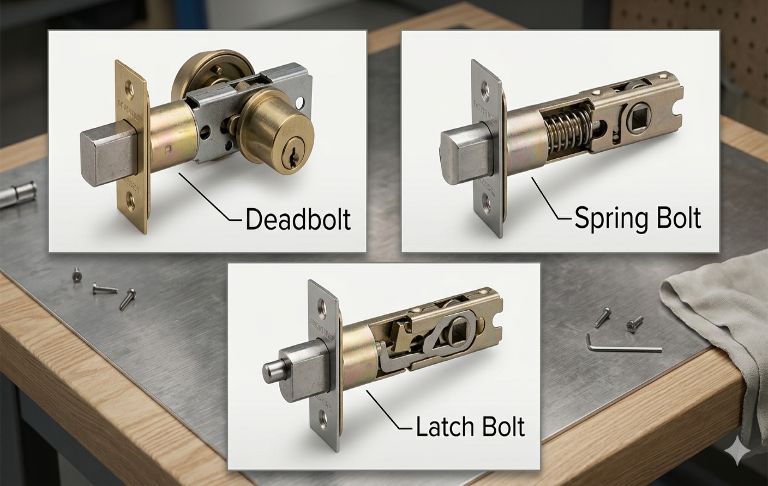
Spring Bolt
Spring bolts are the most common locks used on residential doors. They can often be forced back, hence not very secure.
- Has an angled end
- Automatically retracts upon closing
- Operates through a handle or knob
Deadbolt
If maximum security is desired, a deadbolt is necessary. It cannot be forced back into its original position. The bolt itself is manually operated (through the use of a key, thumb turning disc, etc.) by inserting the key into the bolt cylinder.
- Solid bolt made of metal
- No spring
- Can only operate using a key or thumbturn
There are 2 primary styles of deadbolts available:
- Single cylinder: Key outside and thumb turn inside.
- Double cylinder: Key required for both inside and outside.
Latch Bolt
The latch bolt keeps the door locked, but does not provide security. Purpose:
- Keeps the door from falling out of place
- Prevents the door from swinging open
- Not intended for any security purpose
Chassis or Lock Case
The lock case is the casing that holds all of the pieces together. The chassis, also known as a lock case or lock body, is the main housing for all of a door lock’s internal components. All of the door lock components inside a door lock system contain their own unique function.
However, the chassis will provide the structural foundation to each of these components and ensure the proper operable function of the entire door lock system. Chassis are usually made of metal, and are typically installed inside of a door (exceptions for mortise locks and heavy-duty locking systems). The chassis provides the framework to:
- House internal moving parts of a door lock
- Keep the components aligned.
- Transmit the force from the handle to the cylinder to the bolts.
The chassis for less secure locks, like cylindrical locks, will provide a more compact design, while the chassis for higher security locks, like mortise locks, will provide a larger rectangular shape that is contained inside the door. Key functions of the chassis:
- Provides Solid Support for the Internal Components
- Provides Housing for the Internal Mechanism
- Force Transmission Hub
Internal Mechanism
Inside the lock case, there are a number of different parts of a lock that move against each other and work together. The internal functioning mechanism used inside a lock depends on the style of the lock; however, most functioning locks include the following:
- Follower (or hub): Receives turning motion from the handle’s spindle.
- Lever system: Transmits motion to either the latch or bolt.
- Return springs: Return the handle and latch to their original positions after use.
- Deadbolt connection: Mechanically connects the rotating cam to the bolt.
These internal lock working parts must be perfectly aligned and durable enough to allow for long-lasting and trouble-free service.
Forend/faceplate
The forend is the metal strip that is mounted on the side of the door. The Forend is the plate that is affixed to the face of the chassis, at the edge of the door, that is visible to anyone looking at the doorway. The forend serves four primary functions:
- Covers and protects the internal lock body.
- Provides a clean, finished appearance to the door opening.
- Contains the openings through which the latch and the bolt protrude.
- Provides a method to attach the lock body to the door with screws.
Additionally, the forend is important because it ensures proper alignment between:
- The lock body.
- The strike plate on the door frame.
The forend is the strip of visible metal that is apparent when the door is open. It runs along the edge of the door and usually is held in place by screws. It may have cut-outs where the latch bolt and deadbolt protrude. Acts as the interface between the lock interior and the exterior.
| Types of Forends / Faceplates | Details |
| Square Faceplate |
|
| Rounded Faceplate |
|
| Drive-In Faceplate |
|
Although not movable, the forend plays a crucial role:
- The latch bolt moves through its opening.
- The deadbolt moves through it and into the frame.
- The lock case moves through the forend to the back of it.
- It lines up everything with the strike plate.
A poorly fitted or low-quality forend can contribute to:
- Misaligned latch or bolt
- Difficulty closing or locking the door from the outside and in
- Increased wear on the internal parts of a door lock
- Decreased overall security
A strong, well-fitting forend will provide:
- Smooth operation of the door
- Proper door sealing
- Long-term durability for door operation
Handle and External Hardware
The operation door lock parts are the hardware that people use to operate the lock. They do not lock the door; they just operate the locking mechanism.
- Handles or Levers: Apply pulling force to operate the lock.
- Knobs: Rotate to operate the lock.
- Thumbturns: Manual means of locking the door from inside.
Operation Parts
The operational parts of the door lock are the components that a user directly operates to open, lock, or unlock a door. The cylinder, bolts, and chassis all deal with the internal workings of the lock; however, the operational parts of a door lock are the interaction component that converts human action into mechanical action.
Simply stated, operational parts are how you tell a lock what to do. Operation parts consist of any internal or external parts that allow a user to operate the lock. Examples include:
- Door Handles, or Knobs: The handle (or knob or lever) is the most frequently used and visible operating part of a lock.
- Thumb Turns: Thumb turn pieces are typically installed on doors’ interiors, particularly in deadbolt locks.
- Spindles
- Followers
The operational parts of a lock all work together to transfer motion (turning, pushing, rotating) to the internal mechanism inside the lock case. They are crucial for:
- Usability: Smooth door operation.
- Accessibility: Lever handles ease usability.
- Durability: Reliable components prevent wear.
- Security: Correct interaction guarantees locking.
Mounting and Trim
If mounting is poor, it will cause the handles to have play in them, which can cause internal damage in a short amount of time. These parts of a door lock hold the lock or provide a decorative look to the lock:
- Rose or Escutcheon: Decorative covering.
- Backplate: A mounting plate that is greater than the rose.
- Screws or Fixings: Supportive structure.
Mounting & trim hardware includes all the hardware that will:
- Secure the lock to the door.
- Connect the internal and external components of a lock.
- Cover and protect the installation areas.
Mounting parts of a door lock can be described as the primary structural fasteners that are used to attach the lock parts to the door. By-Bolt may be long bolts which pass through the door. It connects the lock trim on both door sides.
Fixings are more robust and secure than findings with the use of screws. Metal plates are mounted underneath handles or trims. They apply an even distribution of pressure over the surface of the door.
It enhances durability, in particular for frequently used doors. If these components are weak or loose, the lock system as a whole can become shifted, misaligned or even fail regardless of the quality of the other components.
Connecting Parts
In the absence of these connecting parts of a door lock, if you simply turn the handle, nothing would happen inside.
- Spindle: The component to which both handles are attached.
- Follower: The recipient of spindle rotation.
- Fixing bolts: Align the parts and keep them in position.
- Cam Connection / Tailpiece: Connects the cylinder with the lock body
- Transmits the key turning to move the bolt.
- Fixing Screws and Connections: Connects various components (handle, cylinder, chassis)
- Adapters and Clips: Some lock models use these components for compatibility
Connecting parts of a door lock makes sure all the lock’s components move as a single entity. When the lock is properly assembled:
- The mounting parts keep the lock firmly attached to the door.
- Connecting parts connect all moving components.
- Trim parts cover the entire lock.
Door Frame Components
The first thing that many people think of when referring to door locks is the lock itself, but the door frame is just as important. (consisting of the fixed parts of a door lock that surround the door and around which the bolts and latches of the lock are fixed)
A lock will not hold the door closed unless the door frame is sufficiently constructed and aligned. They are part of the locking system that the latch bolt and deadbolt actually engage with. Door frame components are the structural elements around the door opening that:
- Provide support under the door.
- Give a surface to the lock you ran into.
- Ensure axial alignment between moving and fixed components.
- The interaction works like this. And this is precisely how a lock becomes a real security feature.
- Door closes: Latch touches strike plate.
- Latch enters strike hole: Door remains closed.
- Deadbolt moves forward: Makes the lock more secure.
- Force is absorbed by frame components.
Strike Plate/keep
It is the strike plate that the bolt extends into and latches. If the strike plate is weak, the door can be very easily forced open. Functions:
- Traps the latch bolt and deadbolt
- Shelters the frame from damage and abrasion
- Strengthens the locking point
Even the strongest lock can be defeated by a poorly struck strike plate. High security installations utilise reinforced strike plates with deck screws screwed into the wall stud.
Box
There is a box behind the strike plate. Function:
- It softens the blow
- The bolt has the needed space.
- The frame is supported.
Jambs
The door frame’s vertical component on which the strike plate mounts is called the door jamb. Functions:
- Provides structural support for the weight of the door.
- Holds the hinges and the strike plate in place.
- Maintains the alignment of the door relative to the door frame.
Threshold/sill
The lower part of the frame assists with sealing and alignment. The threshold is the bottom of the door frame. Functions:
- Provides protection against the weather (when it is used on exterior doors).
- A place to support the bottom end of the door.
- Assists with the level or equal alignments of all door frame components (jambs and head).
Head
The upper horizontal piece of the frame, the one that encloses the structure. Head (top of the door frame) is the horizontal top of the door frame. Functions:
- Connects both vertical door jambs.
- Maintains the square shape of the door frame.
- Ensures that all sections, including the top and bottom of the frame, are level and equal.
Additional Accessories
Accessories enhance the usability, safety, longevity and privacy of a door’s function and also contribute significantly to the performance of the overall door. Typically, these supporting components do not directly lock the door, but are required in order to ensure that the entire lock system operates correctly.
Bathroom Thumbturn
Basic privacy lock, no key required. The thumbturn is a very simple internal locking device commonly used in bedrooms or bathrooms.
- Installed on the inside face of the door, it consists of a small knob(either vertical or horizontal).
- Rotating the knob (thumbturn) will extend or retract a simple latch mechanism.
- Can be operated by hand and does not require a key to latch and unlatch from the inside.
Features:
- The overall design is intended for privacy purposes only, not for high security.
- It can usually be opened from the outside in the event of an emergency.
Door Closer
Automatically locks the door, enhances security and saves energy. The door is opened manually. Increases fire safety and security control. Benefits:
- Provides security for the building.
- Assists in maintaining proper indoor temperatures through energy savings.
- Reduces costs associated with heating, cooling or other operations of the building.
Hinges
Essential for door movement. These are mechanical joints which attach the door to the frame. They enable the door to swing.
- There are metal plates strapped to the door and frame.
- A central pin enables movement and rotation.
- The door swings freely around this axis.
Key features:
- Structurally balancing the door with a hold-open device
- Without a doubt, the safest way to do this is to weigh the door down so it always remains in the down position.
- Must be tight with good alignment
- The supply is available in a variety.
- Inferior quality hinges can lead to misaligned doors.
- Will directly impact the effective operation of the lock and latch
Door Stop
Protects the wall and locks hardware. Therefore, a door stop is necessary for the door to withstand the impact of full ammunition fired into the room.
- Mounted on the wall, ground or door.
- When the door is swung open, this is felt as the impact is absorbed.
Key features:
- Prevents the scratching of walls, locks and handle plates, doors and door furniture. Decreases noise and impact wear
Main benefit: Prolongs the life of the door and lock system
Peephole/viewer
View outdoors securely without unlocking the door. A peephole or a door viewer will enable you to see outside the door without opening. These technical specifications play an important role in choosing and installing any kind of door lock device. It guarantees the compatibility of the door and the lock. Function:
- A small fisheye lens is attached to the door.
- Offers a panoramic view of the exterior surroundings
- Utilised by the viewer from the inside
Features:
- Increases security prior to unlocking the door
- Mechanical construction (without the need for electricity)
- Some contemporary types may have digital displays.
Purpose:
- Apartment doors
- Front entrance doors
- Technical Specifications
Technical Specifications
Technical requirements are the exact measurements and technical criteria ensuring the door lock will be installed properly and will function safely. Failure to adhere to the mentioned requirements may cause malfunctioning of the lock or prevent its installation.
Backset
Distance from the edge of the door to the centre of the lock mechanism. Must match your door. Improper backset means that the latch is not correctly aligned and therefore, it performs poorly.
- Establishes the location of the lock and latch
- Should correspond with the door’s drilled pattern
Bore Holes
Pre-existing holes to install hardware. It refers to the predrilled spaces in the door which are meant to accommodate lock elements. They should match the particular type of lock. Drilling incorrectly may cause weakness of the door. There are 2 bore holes:
- Big hole: To accommodate the handle or lever mechanism
- Small hole: For the latch mechanism
Handing
Indicates whether the door opens left or right. Handing is a term used to indicate the direction a door opens or closes and how it will function (locking, hinges). Handing affects:
1) The location of the lock and handle
2) Which direction the latch bolt will travel, and whether there is a deadbolt
3) Where the hinges must go for proper alignment of the strike
4) Safety and comfort while using the door
An incorrectly handled door may create the following issues:
- A handle that turns in the opposite direction from intended
- Improper alignment of the latch
BHMA Grading
The grading system also provides a means of measuring:
- Strength and durability of the lock
- Resistance to the force applied to the lock.
- Reliability of the lock over time and the needs of the user when selecting a lock.
Standard of quality:
- Grade 1 → Commercial Grade (highest quality)
- Grade 2 → Residential Strong
- Grade 3 → Standard
Additional Components (depending on lock type)
While all locks work on the basis of a list of core mechanisms, not all locks are created equal. Over the centuries, producers have added refinement and specialised features to accommodate shifting requirements in convenience, security, and looks.
The additional parts of door locks do not appear in every lock, but where they do, they can make a very important difference in terms of performance, user friendliness, and defences against tampering or forced use.
Take the likes of features such as upgrades that turn a basic lock into a more sophisticated system. They can provide extra strength for security in high-risk zones, quicker access for everyday use, or visual upgrades that match the appearance of newer doors.
Some doors, for example, require more support since they are exposed to the outside environment, while others in apartment or business complexes may require pieces that will be used over and over again without deteriorating unnecessarily.
Whether to enhance resistance to burglars, enable keyless locking from inside, or merely to optimize operation, these features deliver value beyond the bare minimum.
With that said, let’s consider the most prevalent added parts of door locks that can be found based on the type of lock.
Deadbolt
The deadbolt is perhaps the most critical security mechanism within modern door systems, which has also been called the “muscle” of a lock. Unlike an automatic retraction spring latch, however, the deadbolt operates by deliberate action, either via turning a key or a thumbturn.
That subtle difference makes it significantly more secure against force entry techniques, such as lock shimming or credit card bypassing, so common with standard spring latches.
A quality deadbolt must be a minimum of 1 inch of bolt length into the doorframe and its hardened steel bolts offer more resistance to cutting or sawing. Pairing a deadbolt with a reinforced strike plate and longer screws is a promise that the frame will hold up to impacts. Here are different types of deadbolts:
- Single-Cylinder Deadbolt
- Double-Cylinder Deadbolt
- Lockable Thumbturn Deadbolt
- Vertical Deadbolt
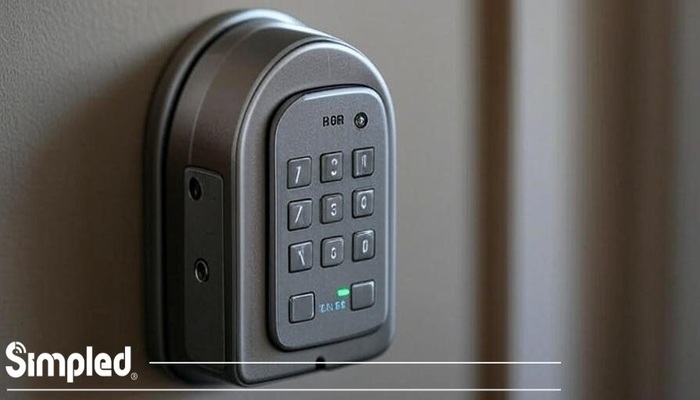
- Smart Deadbolts (Part that is built into the smart door lock)
Thumbturn
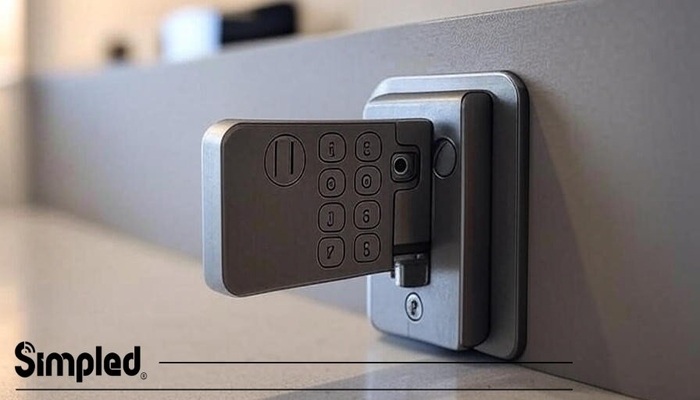
The thumbturn is a small but extremely useful component of a door locking system. In contrast to keys or intricate systems, it’s a simple way to lock or unlock a door from the interior by merely twisting a lever with your fingers.
It’s especially favored in residential settings where access speed and simplicity are desired. That being said, thumbturns also have some security implications. If there are glass windows or panels near a door, an intruder may shatter the glass and grab the lever from inside.
In order to prevent this from occurring, tenants usually pair thumbturn locks with reinforced glass, security films, or by placing the lock in a less accessible position through windows.
In secure locks, double-cylinder deadbolts (key on both sides) are employed by some users, though at the expense of emergency egress ease. Thumbturns generally weigh usability against security to make them ubiquitous throughout modern lock design.
They illustrate the principle that not all parts of a door lock exist to demonstrate brute strength, some are there to simplify life, speed it up, and make it easier.
Spindle
Handle-turning would do nothing without the spindle; it’s the middleman that transmits the motion of your hand to the latch. A smooth-running spindle will provide smooth operation, but a broken or faulty spindle most often leads to frustrating situations: the handle turns round and round without the latch opening, or half-retracts with considerable effort to make the door hard to open.
These types of issues only serve to demonstrate just how vital this small piece could turn out to be. Spindles also differ depending on the design of the lock and door.
There are split spindles and solid square rods, which allow individual handles to operate independently, typical in more complicated lock configurations where internal and external handles are designed to function differently (such as requiring a key from outside but unrestricted movement from inside for security).
Also, the strength and material of the spindle matter. Good quality spindles will be hardened steel for years of reliability, while the poor-quality ones will strip out or bend after some time.
For homeowners as well as businesses, a durable spindle that has been properly installed can prevent a lot of future maintenance issues. In short, although small and so easily overlooked, the spindle is the lifeblood of handle operation.
It’s the piece that translates your turning movement into the movement actually opening the door, proving again that in lock systems, even the smallest elements of door locks are major players.
Faceplate
Faceplate is a small but critical metal plate that is screwed on the door edge where the latch or deadbolt comes out. What looks like a mere ornament is actually much more functional than people can even conceive.
The faceplate is mounted to the edge of the door where the bolt or latch extends. A second most important aspect of the faceplate is its protective function. With doors usually being yanked on, slammed, or subjected to a sharp impact, the faceplate distributes a portion of that stress across its rugged metal surface rather than letting the wood take all of it.
That small amount of support may be the difference between a strong door that will last for years and a door that quickly wears out around the locking point. Faceplates are available in shapes and sizes depending on the lock type and door shape. This part of door lock:
- Supports the bolt or latch
- Protects the edge of the door from wear
- Typically coordinated with the finish of the lock for appearance
Escutcheon
The escutcheon is a decorative cover over the handle or keyhole. It also gives protection against tampering. Which one do you choose? Plain or ornamental? Typically used with a backplate for additional protection.
Backplate
The backplate is mounted behind the knob or handle and provides further support to heavy locks or doors. It enhances longevity. Backplate can improve security by preventing the handle from getting knocked off.
Conclusion
It’s more than technical knowledge to learn about the parts of a door lock, it’s understanding how each little component is connected to deliver security, safety, and convenience into your existence.
We have explained different parts of door locks in this blog. For professional door lock assistance and reliable backup, check out Simpled products. Their team ensures that every component, from cylinder to backplate, functions flawlessly, giving you security and peace of mind.




Leave a Reply